
Undergraduate Research Competition
Development of a UV-LED Based Air Purification System :
Multidisciplinary Undergraduate Research Competition (my slides):
Literature Review: Improving Design and Safety in UVC-LED Air Purification Systems
1. Literature Review:
How can the design and safety considerations be improved in a UVC-LED air purification system?
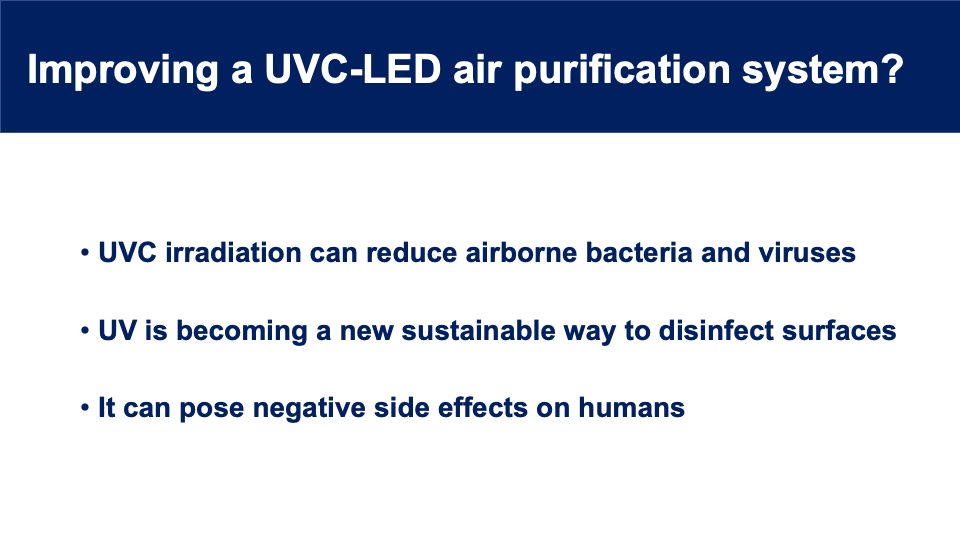
Given that ultraviolet (UV) radiation is capable of inactivating microorganisms and viruses, a great deal of interest is in how UV-LEDs can be used to purify the air that may contain SARS-CoV-2 virus, which causes the COVID-19 disease. However, UV radiation can pose many negative side effects on human beings. Consequences of UV exposure can be seen rapidly in sunburns, or in delayed forms, such as skin cancer. Moreover, the eye can suffer major retinal damage from UV rays (Raeiszadeh & Adeli, 2020). Eisenlöffel et al. studied the impact of airborne bacteria in a pig facility, comparing amounts of bacteria in the air of a regular facility to a UVC air filtered facility. Their research suggests that combining UVC irradiation with recirculating air is proved to be effective and successful in reducing airborne bacteria and viruses. Similarly thinking of reducing airborne bacteria, Bergam et al. designed an air purification device where particles were trapped in a HEPA filter that received a UVC dose of 1.23 mJ/cm2 from a UVC-LED. This resulted in approximately 90% of SARS-CoV-2 becoming inactivated in 88.9 ms of 1 W UVC exposure (Bergam et al., 2020). Additionally, Raeiszadeh and Adeli reviewed emerging new research in ways to disinfect surfaces and air with respect to COVID-19, concluding that UV is becoming a new sustainable way to do so. Although UV is effective in disinfecting even if manufacturers provide the most effective system for UV disinfection, their effectiveness depends on the degree of diligence on the user’s side to determine its success (Raeiszadeh & Adeli, 2020).
2. Methodology:
How can the design and safety considerations be improved in a UVC-LED air purification system?
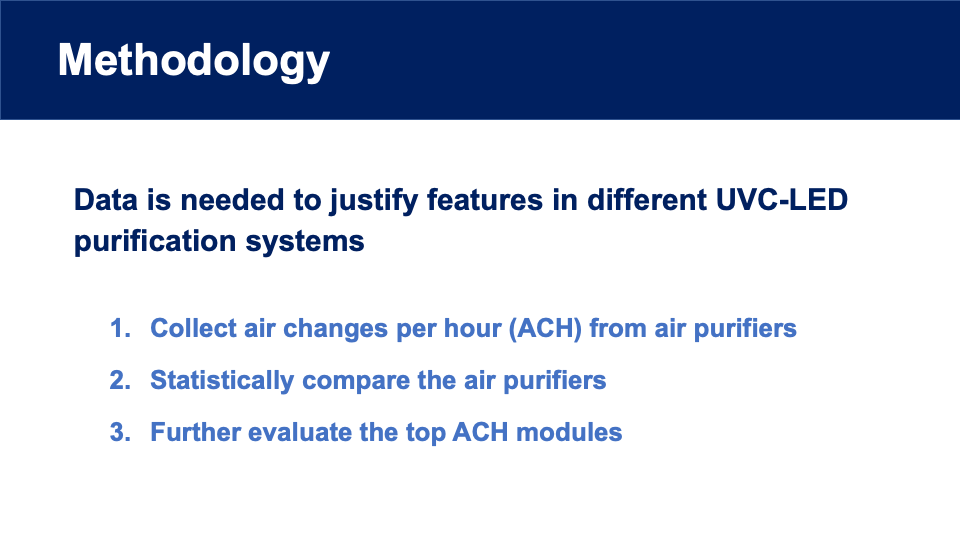
In order to establish a relationship concerning the improvement of the design and safety of a UVC-LED air purification system quantitative data can be collected, which then can be evaluated through further statistical testing and comparisons with other UVC-LED purification systems. Quantitative and experimental data will be needed to highlight and justify certain features in different UVC-LED purification systems. Quantitative and experimental data can be collected by observing the air changes per hour (ACH) of the air purifier in the theoretical room, similar to research done by Bergam et al. (2020). ACH is calculated as follows: ACH = Q ∗ 60/V where Q volumetric flow rate of air in cubic feet per minute, and V is the volume of the room; a higher ACH value indicates better circulation. An ACH value of 3.5 is the minimum in Vancouver buildings according to B.C. Housing Guidelines, and due to COVID-19 air ventilation improvements have been recommended by the Centers for Disease Control and Prevention (CDC). Furthermore, a higher ACH value means the device will take overall less time to remove airborne containments in the air. After evaluating different UVC-LED purification systems the top three ACH modules can be looked at to be able to highlight certain features and designs which can improve the design and safety considerations in the next UVC-LED purification systems.
References:
3. Results and Discussion:
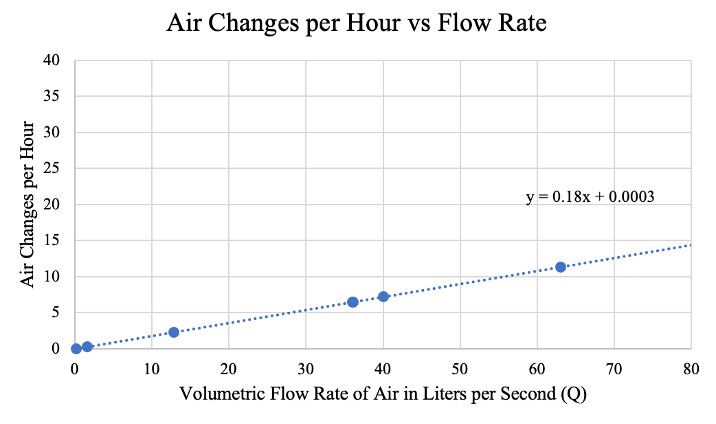
Figure 1.0:
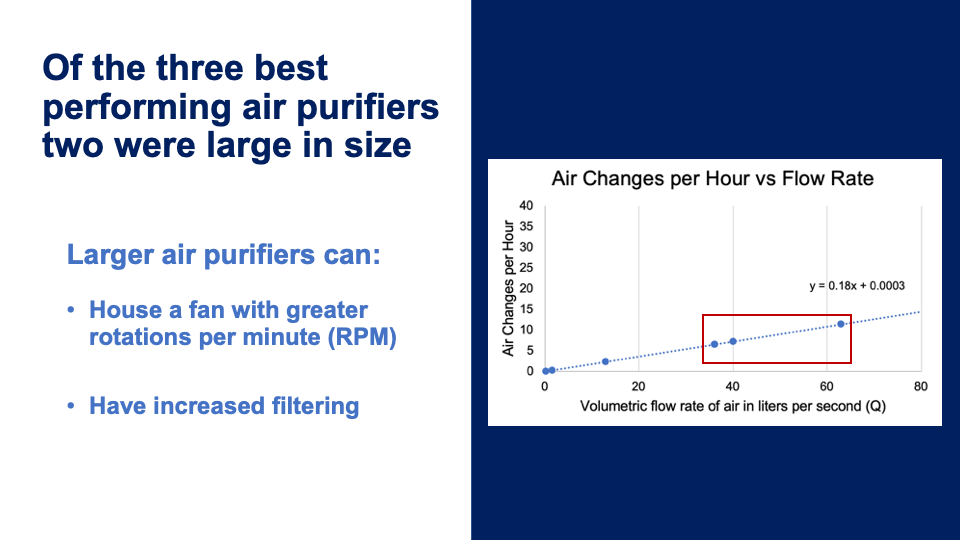
In the data collected the following assumptions were made: the room was indoors, there was no wind activity, there were no people in the room and the room was 20 m3 in volume. After these assumptions ACHs of various common air purifiers were recorded. The mean ACH from all devices was 8.22; however, the median ACH was 4.97. From the Air Changes per hour vs Flow Rate graph a relationship between flow rate (Q) and ACH can be made. A Q value of 19 l/s will be able to provide an ACH of 3.5 which according to B.C. Housing Guidelines is optimal for small settings. When observing the three best performing air purifiers two of the three were larger in size; greater than 60 cm in height, which were able to house a fan with greater rotations per minute (RPM). Additionally, of the three, the two larger devices had more filtering abilities possibly due to the device having larger filters; therefore, increasing the area in which microorganisms and viruses can be eliminated.
 |
 |
 |
|---|---|---|
| Figure 2.0 | Figure 2.1 | Figure 2.2 |
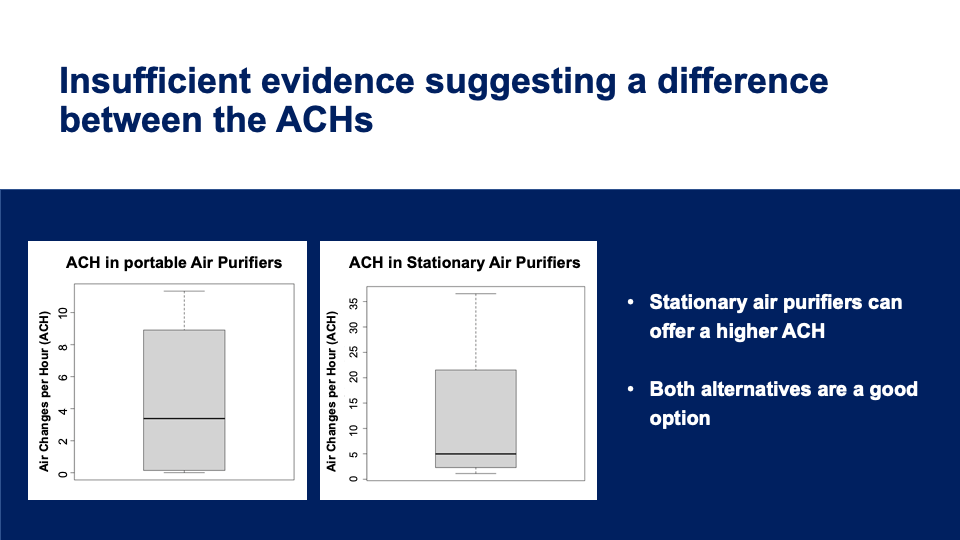
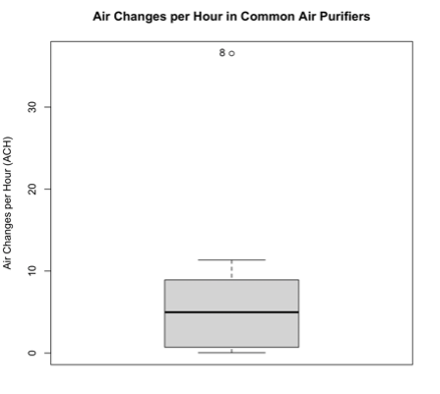
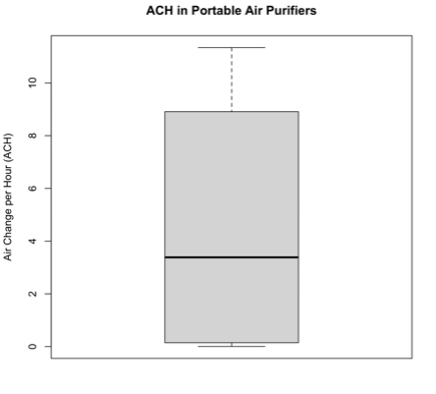
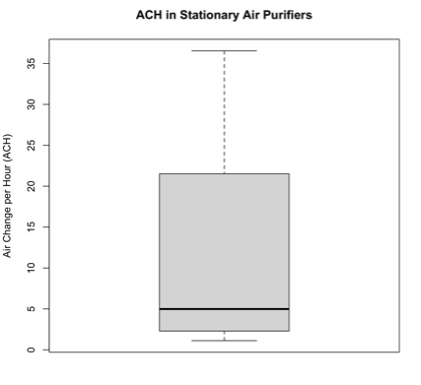
| The boxplot in figure 2.0 represents the ACH of all tested air purifiers. The ACHs have a mean of 8.22 and a median of 4.97. The max and min ACHs were 36.54 and 0.0036 respectively. Q1 and Q3 with ACHs of 0.91 and 7.71 respectively. | The boxplot in figure 2.1 represents the ACH of portable air purifiers. The ACHs have a mean of 4.53 and a median of 3.38. The max and min ACHs were 11.34 and 0.0036 respectively. Q1 and Q3 with ACHs of 0.22 and 7.70 respectively. | The boxplot in figure 2.2 represents the ACH of stationary air purifiers. The ACHs have a mean of 11.91 and a median of 4.98. The max and min ACHs were 36.54 and 1.12 respectively. Q1 and Q3 with ACHs of 2.88 and 14.01 respectively. |
Figures 2.0, 2.1, 2.2:
From the data collected from various common air purifiers on the market, boxplots were made. Air purifiers come in a range of sizes which will be categorized as portable or stationary. A portable air purifier has a size of 10 cm x 20 cm x 5 cm, approximately handheld, whereas a stationary air purifier is anything over 60 cm tall and is meant to be positioned on the ground in a larger room. The findings indicate that portable air purifiers have an average ACH of 4.53 and the stationary air purifiers have an average of 11.09 ACH. However, unexpectedly upon further statistical testing with an alpha of 0.05, there is insufficient evidence to suggest that there is a difference in ACHs between the portable and stationary air purifiers at the given alpha level. Again, the ACHs were calculated with the previous assumptions such as being in an indoor space, there were no people in the room, and tests were done in a smaller room of about 20 m3. Therefore, with the found data both alternatives would be a good option to increase airflow in a room.